Long ago in India, in the city of Seri, there were two merchants who made their living by selling pots, pans, and other household items. They would travel from village to village, each pushing a cart filled with goods. One of them was greedy and dishonest, while the other was kind and fair in his dealings. One day, both merchants happened to visit the same town, though at different times. In this town lived a poor old widow and her young granddaughter. They owned nothing of value except an old, blackened bowl that had been passed down through generations. Not knowing its true worth, they kept it among their simple belongings.
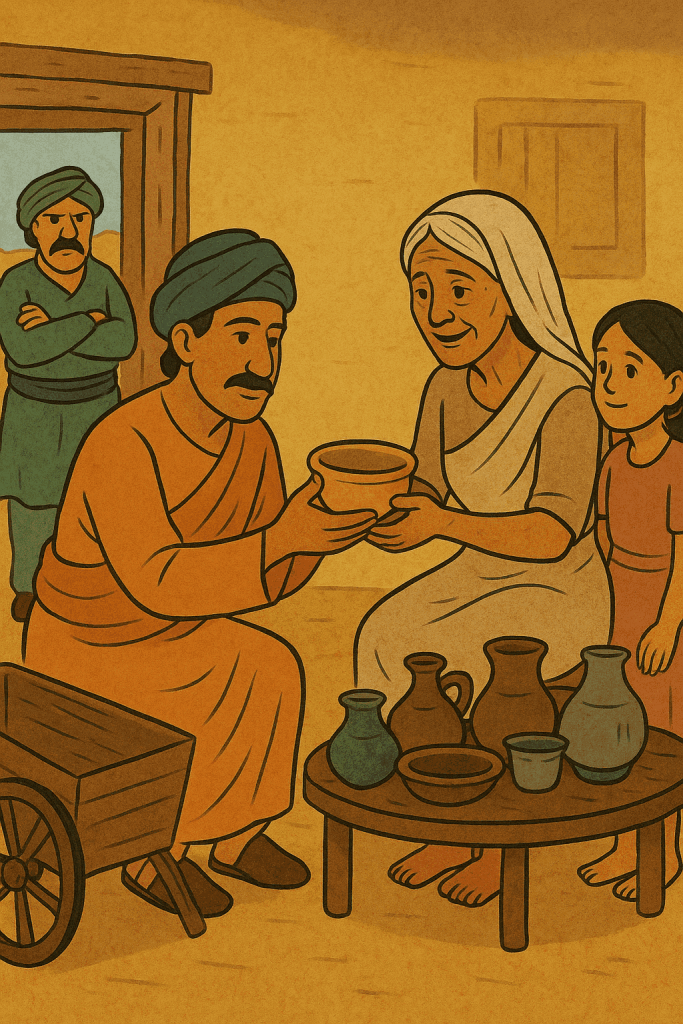
The greedy merchant was the first to arrive at their home. The little girl asked her grandmother if they could trade the bowl for something useful. The grandmother agreed and brought out the old bowl to show the merchant. The moment he saw it, he realized it was made of pure gold, though tarnished by time and use. However, he decided not to reveal this and instead scoffed at it, saying it was worthless. He hoped the widow would believe him and discard the bowl or sell it later for a few coins. He left with the intention of returning later to buy it at a low price or perhaps steal it.
Soon after, the honest merchant came to the same house. Again, the little girl brought out the same bowl and asked if they could exchange it for a simple utensil. As soon as the honest merchant examined it, he realized that it was a solid gold bowl. Unlike the previous merchant, he chose to act with honesty. He told the grandmother and the child about the bowl’s true value and offered them everything he had on his cart in exchange—his pots, pans, and even some coins. He said he could not cheat them and it was only fair they receive full value for their item. The widow and her granddaughter were overwhelmed with gratitude and accepted his offer with joy.
When the greedy merchant returned later that day and found the bowl gone, he was furious. He rushed to the honest merchant and accused him of stealing his treasure. But the townspeople, having heard of the honest merchant’s fairness, praised him and shamed the greedy one for trying to deceive a poor widow. Realizing his own folly and driven by his anger and jealousy, the greedy merchant left the town humiliated and heartbroken.
Moral: Honesty and integrity bring true and lasting rewards, while greed and deceit lead only to loss and disgrace.