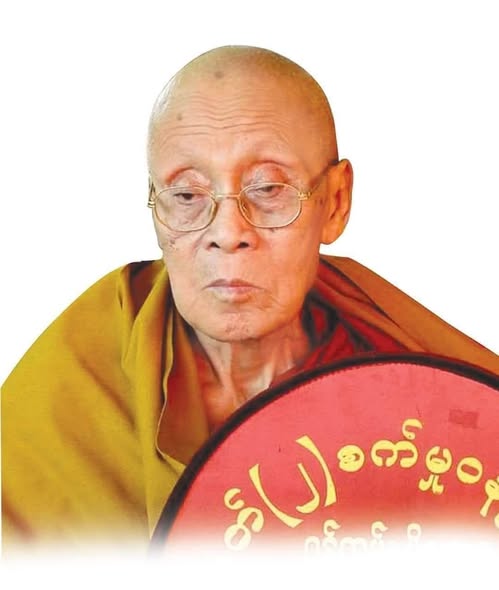
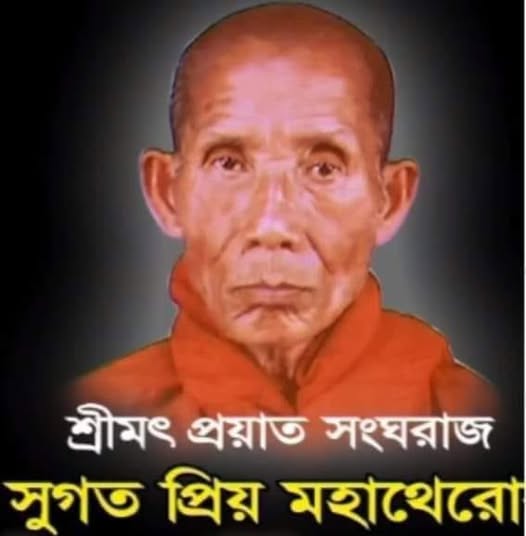
Rajguru Agnibansha Mahathera: Founder of PBSB and Participant of the Sixth Buddhist Council

The 58th Annual Grand Conference of PBSB was held at Moanoghar, Rangamati. Geographically, the Chittagong Hill Tracts (CHT) are connected to the northeastern hill states of India and the western border of Myanmar. To the north and northwest lies Tripura (India), to the south is Arakan (Myanmar), to the northeast is Mizoram (India), and to the west are the coastal plains of Chattogram and Cox’s Bazar in Bangladesh.
For centuries, indigenous communities such as the Chakma, Marma, Tanchangya, Tripura, Khiyang, Mro, Lusai, Khumi, Pangkhoa, and Chak have coexisted in harmony in this region. Among them, the Chakma, Marma, Tanchangya, Khiyang, Mro, and Chak people have traditionally followed the compassionate teachings of the Buddha.
The revival of Buddhism in the Hill Tracts has deep historical roots. Despite communal oppression, natural disasters, and political instability, the indigenous Buddhists of the region have held firmly to their faith. Although deprived of formal education for long periods and often steeped in folk rituals and non-Buddhist practices like river and goddess worship, their cultural and spiritual connection to Buddhism remained intact.
Even with limited doctrinal knowledge, early Buddhist priests contributed significantly to preserving the faith. The principles of Buddhism are embedded deeply in their blood and culture, making it impossible for them to abandon the religion.
Rani Kalindi: A Pioneer in Reviving Buddhism
A major turning point in the Buddhist revival in East Bengal came in 1844 when Rani Kalindi, a devout and wise queen of the Chakma people, took interest in preserving and promoting Buddhism. Though initially a follower of Tantric Buddhism, she later converted to Theravāda Buddhism under the guidance of Venerable Saramedha Mahasthavira, a respected monk whom she met during a religious discourse. Impressed by his teachings, she invited him to her palace and formally took refuge in Theravāda Buddhism.
To honor his wisdom, in 1857 during a royal event, she conferred upon him a title in Arakanese and granted him high esteem. From then on, Venerable Saramedha became known as the Sangharaja (Chief Monk) of the region.
Rani Kalindi established the first monastic boundary (sīmā) at the Rajanagar Royal Monastery, where about 90% of monks in the region ordained in accordance with the Vinaya (monastic code). Thus, the Sangharaja Nikaya was born—a Theravāda lineage that remains influential among Bengali Buddhists to this day.
The Sixth Buddhist Council and the Emergence of PBSB
The Sixth Buddhist Council was held in 1956 at Kaba Aye Cave in Rangoon, Myanmar. It was a historic event that not only examined the Vinaya but also scrutinized the commentaries and sub-commentaries of the Tipiṭaka.
From then East Pakistan (now Bangladesh), Venerable Agnibansha Bhikkhu participated as the sole Buddhist monk representing the Chittagong Hill Tracts. During the Council, Chakma King Tridev Roy also attended as a distinguished guest and became acquainted with Agnibansha Bhikkhu, then a rising monk of the Tanchangya community.
As a result of this association, and following the relocation of the Chakma royal estate to Rangamati due to the Kaptai Dam project, King Tridev Roy invited Agnibansha Bhikkhu to become Rajguru (Royal Preceptor) of the Chakma Royal Monastery. He accepted the invitation and moved to Rangamati in 1958.
That same year, Rajguru Agnibansha Mahathera founded the Chittagong Hill Tracts Bhikkhu Association, which later evolved into PBSB.
Transformation into Parbatya Bhikkhu Sangha Bangladesh
Due to political unrest in 1976, Rajguru Agnibansha Mahathera was forced into exile. Leadership of the organization was then passed to Venerable Bimal Bansha Mahathera, abbot of Maitri Vihara in Rangamati. In 1978, Venerable Prajñānanda Bhikkhu was appointed General Secretary of the organization.
That same year, in coordination with Parbatya Bauddha Sangha (established in Dhaka in 1976 by indigenous Buddhists), a conference was held that officially dissolved the previous name and re-established the organization as Parbatya Bhikkhu Sangha Bangladesh (PBSB).
Present Status
By 1981, the formerly unified Chittagong Hill Tracts were administratively divided into three districts: Khagrachari, Rangamati, and Bandarban. Today, these districts are home to over 1,000 Buddhist monasteries and approximately 3,000 monks, including Theras and Mahatheras, who are dedicated to the practice and propagation of Theravāda Buddhism.
Since its founding, PBSB has been devoted to spiritual discipline, moral education, and social development based on the Buddha’s teachings. It is a non-political, non-profit monastic organization, where only ordained Buddhist monks are eligible for membership.Belief and Vision
PBSB upholds respect for all religions and strives to foster human dignity, moral values, and mental development through the practice of pure Dhamma, contributing to both personal and societal well-being.