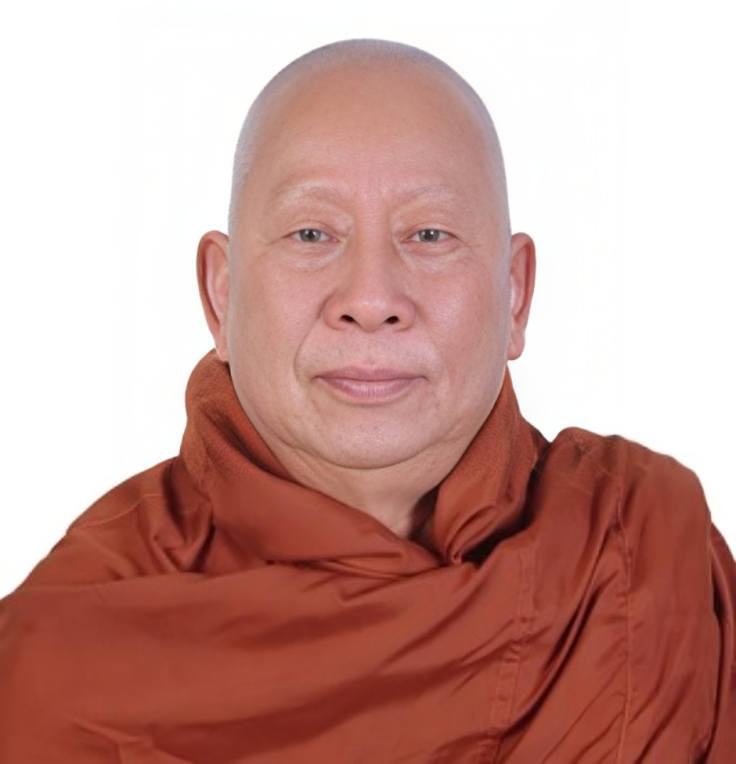
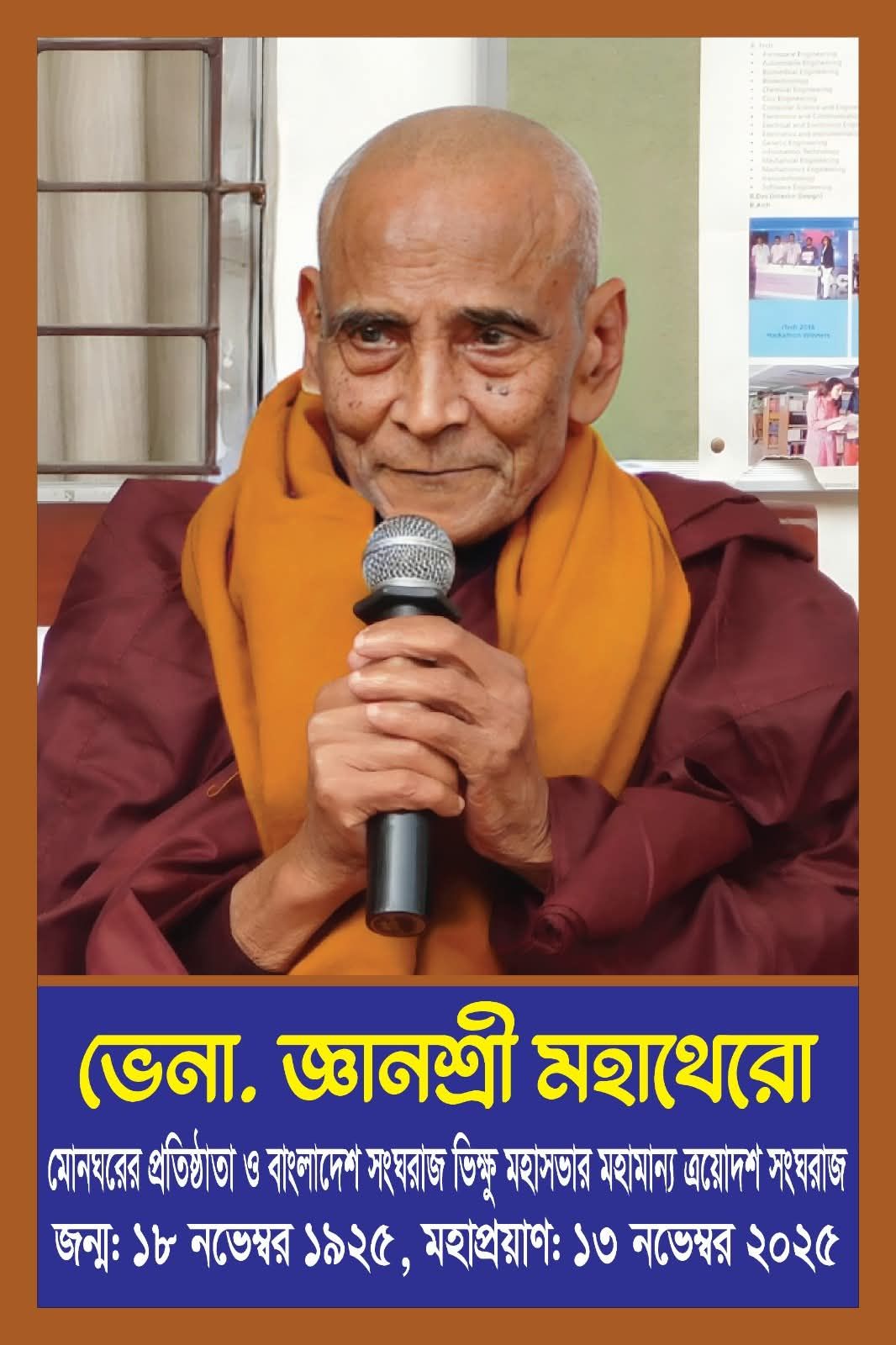
Founder of Monoghar and the 13th Sangharaja of the Bangladesh Sangharaja Bhikkhu Mahasabha
Saddhammaditya Dr. Jñānashrī Mahāthero, the Founder of Monoghar, the Honorable 13th Sangharaja of the Bangladesh Sangharaja Bhikkhu Mahasabha, and an Agra Mahāpandit, attained Mahāparinibbāna on 13 November 2025 (CE) at the venerable age of over one hundred years. He was a pioneering figure in leading the ashram-based education movement for Buddhist monks and lay communities in the Chittagong Hill Tracts.
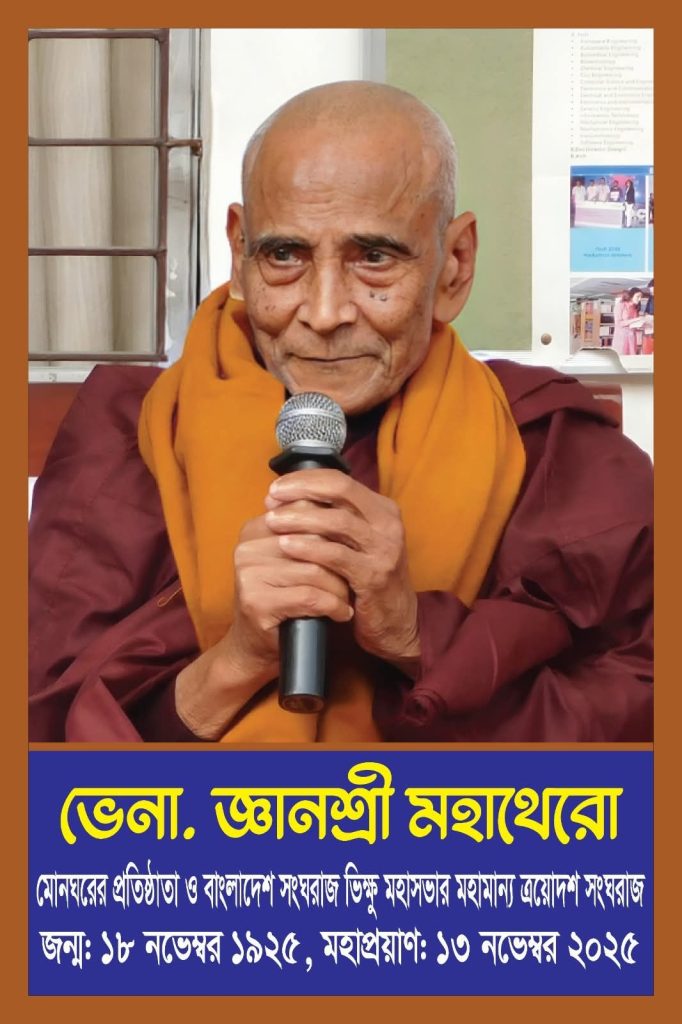
To pay homage and express deep reverence, his sacred relics were brought to the Monoghar Campus, where Anicca assemblies, remembrance sessions, and Punnānumodana (dedication of merit) ceremonies were organized. At the opening of the program, his brief life history was presented by Mr. Shyamal Mitra Chakma, former Principal of Khagra College and Member of the Advisory Council of Monoghar Residential School and College. For the awareness of all, a summary of the venerable life of Dr. Jñānashrī Mahāthero is presented below.
1. Birth and Family Background
The life of the great scholar Śrīmat Jñānashrī Mahāthero, honored with the title Aggamahāsaddhammajotikādhvaja, was illustrious and dedicated to tireless service. He was born on 18 November 1925 in Domkhali village, North Gujara, Chattogram District. His lay name was Lokanath Barua. His father was Prem Lal Barua, and his mother Menka Barua, who passed away during his early childhood. Though he faced maternal loss at a young age, he was lovingly raised by his stepmother Snehalata Barua, his grandmother Naba Kumari Barua, and through his father’s affection.
2. Educational Life
He began his education at a village primary school and later studied at Binajuri Nabin M.E. School and Mirzapur High School. Due to the turmoil caused by the Second World War, his education was temporarily disrupted. Later, his maternal uncle Nagendra Lal Barua (who later became a monk) took responsibility for his studies and enrolled him at West Binajuri Sonairmukh Primary School, where he completed his primary education.
3. Monastic Life (Pravrajyā and Upasampadā)
After completing primary education, Lokanath Barua came under the guidance of Venerable Sārānanda Bhikkhu, through whom he developed deep devotion to the Saddhamma, discipline, and righteous conduct. He actively engaged in organizing religious programs, Dhamma discussions, and living a Vinaya-based life.
In 1944, he received Pravrajyā (novice ordination) and entered the Buddha’s dispensation. His preceptor was Venerable Guṇālankāra Mahāsthavira, the then Deputy Sangharaja and Principal of Jobra Sugata Monastery. After ordination, his monastic name became Jñānashrī, meaning “the brilliance of noble wisdom.”
He resided at Shantidham Monastery in Mirzapur, Hathazari, where he practiced monastic discipline and managed monastery affairs. In 1949, under the guidance of Deputy Sangharaja Guṇālankāra Mahāsthavira, he received Upasampadā (higher ordination) at the historic Rājanagar Shakyamuni Monastery in Rangunia, established by Queen Kalindi, consort of the Chakma Raja. Thus began the venerable monastic life of Jñānashrī Mahāthero.
As a monk, he propagated the Saddhamma across both hill and plain regions. In 2020, he was elected as the 13th Sangharaja of the Bangladesh Sangharaja Bhikkhu Mahasabha, the highest religious authority of Buddhists in Bangladesh.
4. Arrival in the Hill Tracts
The arrival of Saddhammaditya Jñānashrī Mahāthero in the hill regions was like a life-giving monsoon after a long drought—a great blessing and a source of peace for the hill communities.
In response to an invitation from Headman Bindu Kumar Khisa of Mahalchhari Upazila (present-day Khagrachhari District), who sought a monk to serve as abbot of a newly built monastery, Venerable Jñānashrī Mahāthero came to the Chittagong Hill Tracts in 1958 under the directive of his preceptor, Deputy Sangharaja Guṇālankāra Mahāsthavira. He resided at the Buddhist Monastery of Mubachhari, under the care and management of the Khisa family—whose contribution is remembered with deep gratitude.
Following the construction of the Kaptai Dam in 1960, the Mubachhari Monastery was submerged, and he later moved to Boalkhali Dashabal Chakma Rajbihar in Dighinala.
5. Initiation of the Ashram-Based Education Movement
The construction of the Kaptai Dam displaced thousands of people, leaving them homeless and impoverished. Venerable Jñānashrī Mahāthero realized that the propagation of the Dhamma is impossible among people suffering extreme poverty. He understood that education is the only path to liberation from such hardship, and that general education is essential for cultivating Saddhamma consciousness.
With this vision, he established the Parbatya Chattal Buddhist Orphan Ashram in 1961, initiating the ashram-based education movement for neglected, orphaned, and underprivileged hill children.
Alongside Dhamma propagation, he founded numerous educational institutions. Among the most notable are Parbatya Chattal Buddhist Orphan Ashram and Monoghar Shishusadan. Under his overall guidance and financial support, Monoghar was established in 1974 at Rangapani village, Rangamati Sadar.
His devoted disciples Venerable Bimal Tissa Mahāthero, Venerable Prajñānanda Mahāthero, Venerable Shraddhalankar Mahāthero, Venerable Priyatissa Bhikkhu, and Venerable Jīnapāla Bhikkhu, among others carried forward the mission with his blessings.
For over five decades, Monoghar has been spreading the light of education in the hill tracts and is now recognized as a “Lighthouse of Education” in the region.
Beyond the hill tracts, Sangharaja Dr. Jñānashrī Mahāthero also established nearly fourteen educational institutions in the plains. In addition to education, he made outstanding contributions to Dhamma development, propagation, authorship, and publication of religious texts.
6. Honors and Recognitions
For his extraordinary contributions to the propagation of the Saddhamma and the expansion of education, Sangharaja Dr. Jñānashrī Mahāthero received numerous national and international honors, including:
- 1981 – Shāsana Shobhana Jñānabhānaka title, awarded by Wat Paknam Bhasicharoen, Bangkok, Thailand
- 2007 – Mahāsaddhammajotikādhvaja title, awarded by the Government of Myanmar
- 2007 – Honorary Doctorate Degree from Mahachulalongkornrajavidyalaya University, Thailand
- 2023 – Agraha Pandit title, awarded by the Government of Myanmar
- 2022 – Ekushey Padak, awarded by the Government of Bangladesh for social service
In 2001, he was honored with the title Vinayācārya by the Bangladesh Sangharaja Bhikkhu Mahasabha. Finally, on 20 May 2020, he was elected as the Honorable Sangharaja, the highest recognition of the Mahasabha.
The 13th Sangharaja, Saddhammaditya Dr. Jñānashrī Mahāthero, attained Mahāparinibbāna on 13 November 2025 (CE).